Impact of Urbanization on Rainfall Patterns and Flood Risk
By the end of this century, around 80% of the world’s population is expected to live in cities. As urban areas expand, their influence on the atmosphere and the water cycle grows stronger, shaping local weather and hydrological extremes in complex ways. Cities profoundly affect the lower atmosphere and rainfall through multiple interconnected mechanisms.
One of the most important is the urban heat island effect: urban areas tend to be around 2 °C warmer than the surrounding countryside because asphalt, buildings, and concrete absorb and retain solar radiation. This warm dome alters air circulation, while the increased surface roughness created by buildings slows down winds and further modifies local flow patterns.
Urban environments also emit large quantities of aerosols, which can act as cloud condensation nuclei. These tiny particles serve as seeds for cloud droplet formation, influencing cloud development, lifetime, and ultimately where and how much rain falls.
Using high resolution numerical simulations with the Weather Research and Forecasting Model coupled with Chemistry, we investigate the magnitude and distinct characteristics of these mechanisms for present time and future urban projections. Our analyses focus on a range of weather systems, including extreme precipitation events, and explore how urbanization can intensify flood risk in major U.S. cities. This integrated approach provides valuable insights into how growing urban areas reshape atmospheric processes and hydrological hazards.
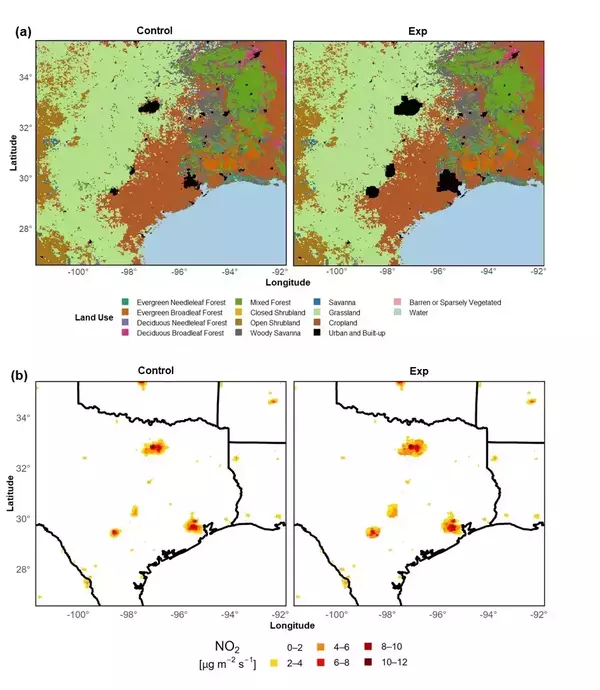
Present time and projected future Texas major cities by 2100.
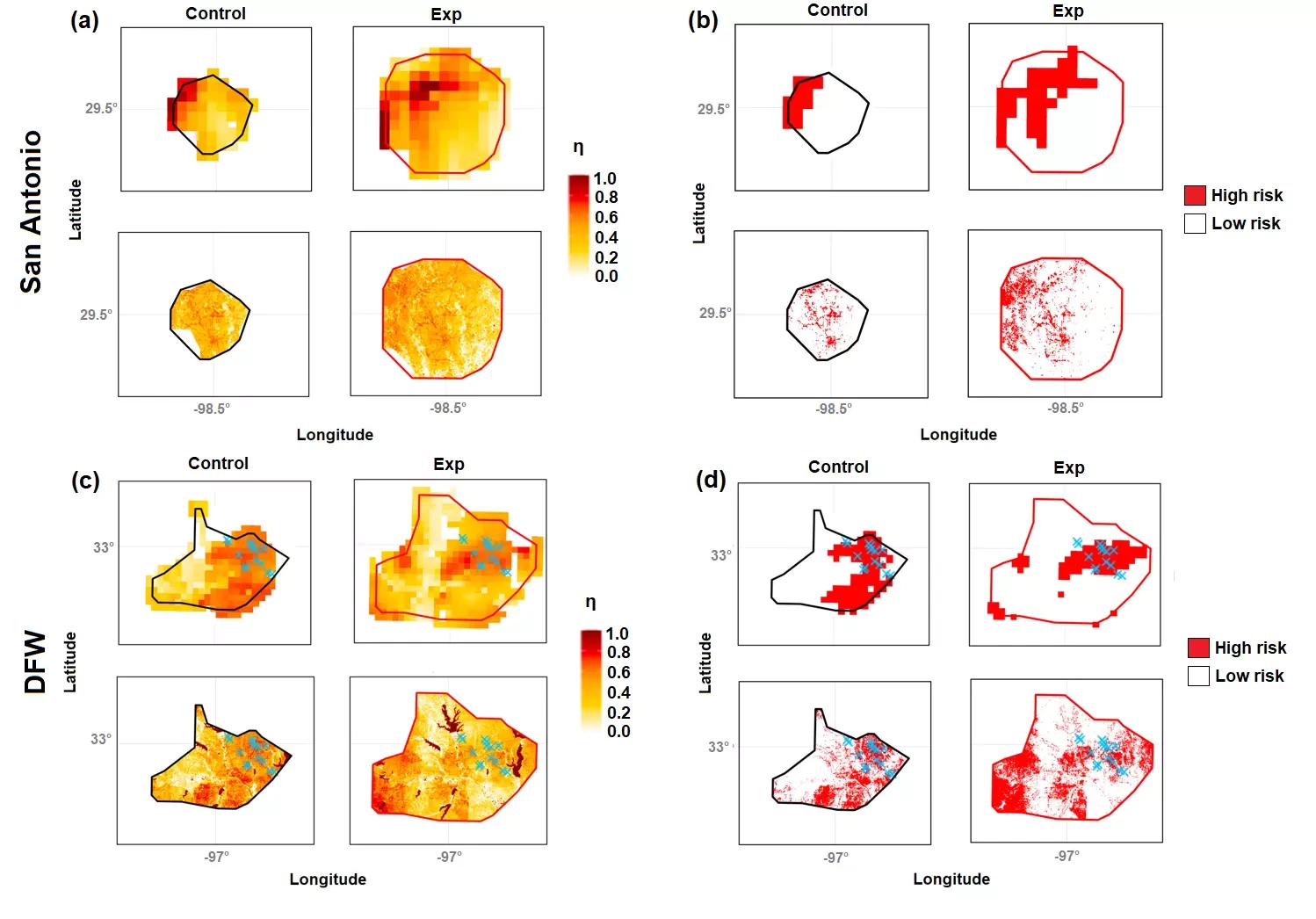
Flood risk analysis over San Antonio and Dallas-Fort Worth.
Relevant Publications:
- Moraglia, G. and Crippa, P. (2025): Assessing the influence of aerosols on urban precipitation: A sensitivity study of Dallas–Fort Worth. Atmospheric Research, 328, doi:10.1016/j.atmosres.2025.108436.
- Moraglia, G., Pryor, S. C. and Crippa, P. (2024): Quantifying the impacts of an urban area on clouds and precipitation patterns: A modeling perspective. Journal of Geophysical Research: Atmospheres, 129, e2024JD041402, doi:10.1029/2024JD041402.
-
Zhou, X., Letson, F., Crippa, P. and S.C. Pryor and (2024): Urban effect on precipitation and deep convective systems over Dallas-Fort Worth, Journal of Geophysical Research: Atmospheres, 129, e2023JD039972. doi.org/10.1029/2023JD039972.