Coupled meso- to micro-scale simulations
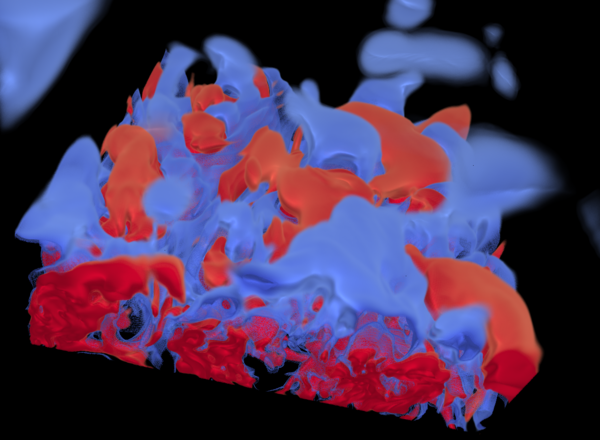
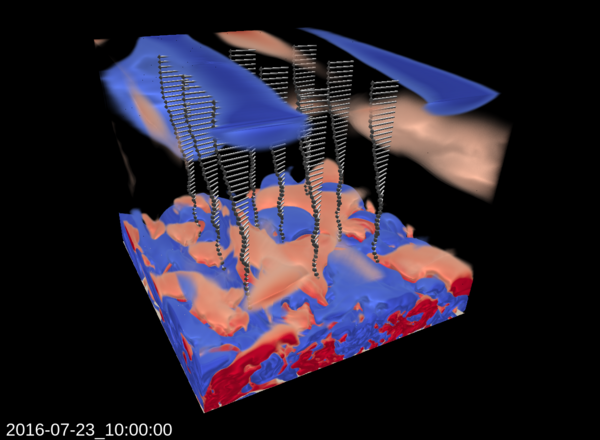
Aiming to represent local features of atmospheric dynamics in numerical models (e.g. microscale circulations, concentration of pollutants at neighborhood scale), the group investigates how traditional mesoscale models, which use horizontal grid spacing (∆x) on the order of 10km, can be coupled with microscale and large eddy simulations, where ∆x is on the order of 100m or below. The transition between these two types of models is particularly challenging in the so-called terra incognita (gray zone, ∆x~1km), where the length scales of convective turbulent structures become comparable to the model resolution, invalidating the assumptions of most of the available turbulence models.
Relevant Publications:
-
Giani, P. and Crippa, P. (2024): On the Sensitivity of Large Eddy Simulations of the Atmospheric Boundary Layer Coupled with Realistic Large Scale Dynamics, Monthly Weather Review, 152, 1057–1075, doi:10.1175/MWR-D-23-0101.1.
-
De Moliner, G., Giani, P., Lonati, G. and Crippa, P. (2024): Sensitivity of multiscale large Eddy simulations for wind power calculations in complex terrain. Applied Energy, 2024. 364: p. 123195.
- Giani, P., Katia Lamer, Crippa, P. and Michael J. Brown (2024): Formulation, Implementation and Validation of a 1D RANS Inflow Scheme for the QUIC Modeling System, Boundary Layer Meteorology, 190, 17 (2024). doi:10.1007/s10546-024-00860-2.
- Giani, P., Genton, M.G., Crippa, P. (2022). Modeling the convective boundary layer in the Terra Incognita: Evaluation of different strategies with real-case simulations. Monthly Weather Review, doi.org/10.1175/MWR-D-21-0216.1.
Interactive Dataset from [1]: https://kranke-acamg.shinyapps.io/shiny-app1/